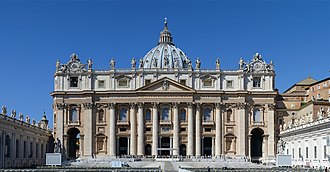
St Peter's Basilica, the largest church in Christendom by interior volume, stands over what tradition holds is the burial site of Saint Peter, the apostle regarded as the first pope. Planning ahead for St Peter's Basilica tickets, guided entries, and dome ascents ensures you make the most of this historic sanctuary.
Fast-track security entry, reserved dome climb elevators & official Vatican accredited guides.
Michelangelo's monumental dome commanding the Roman horizon, seen across the western ridges.
Best Months
October to April
Pleasant temperatures, fewer crowds
Visit Length
2.5 to 3.5 Hours
Includes dome climb & grottoes
Rough Cost
Free (€0 Entry)
€8–€10 dome / paid tours optional
Busiest Days
Wed & Sat
Papal Audience mornings on Wed
Sacred Ground & Renaissance Genius
Welcome to the Heart of the Vatican
St Peter's Basilica, the largest church in Christendom by interior volume, stands over what tradition holds is the burial site of Saint Peter, the apostle regarded as the first pope. Built over 120 years starting in 1506 and completed in 1626, it brought together the era's greatest architects and artists, including Michelangelo, who designed its 136.6-meter dome, and Bernini, whose massive bronze baldachin canopies the papal altar. Entry to the basilica is free, but the security line at St Peter's Square can take over an hour without planning. This guide covers the must-see interior features, the dome climb, dress code, and how to avoid the worst of the queues.
Before setting out, smart pilgrims and architecture admirers always compare all the tours side by side to evaluate whether self-guided queuing or fast-track escorted entry best fits their itinerary. From subterranean early Christian catacombs to the lantern above Rome's highest masonry pinnacle, every square meter bears witness to twelve centuries of unbroken devotion, artistic rivalry, and architectural daring.
Popular Vatican Access & Experiences
Side-by-Side Comparison
Comparing St Peter's Tour & Ticket Options
Every traveler moves at a different pace. Use this objective breakdown to match your budget, physical endurance, and available hours in Rome.
Tour
How long
Rough price
Who it suits
Skip it if
St Peter's Basilica skip-the-line entry
1-2h inside
€
independent travellers who just want the queue skipped
you are visiting off-season, when there is no queue to skip
St Peter's Dome climb ticket
self-paced
€
anyone who would rather earn the view
mobility is a concern — there are steps and uneven ground
Vatican Museums, Sistine Chapel, and St Peter's Basilica combined tour
about half a day
€-€€
anyone with half a day and no fixed plan
you are on a tight budget; the free alternative covers most of it
St Peter's Basilica guided tour
about half a day
€€
repeat visitors looking past the obvious
you dislike early starts
Vatican Necropolis (Scavi) tour to St Peter's tomb
3-4h
€€
first-timers who want the headline sights
you only have a few hours in town
Sistine Chapel early morning access tour
an afternoon (4h)
€-€€
repeat visitors looking past the obvious
you only have a few hours in town
* Note: Basic general entry to the basilica nave is free of charge via the public security line in St. Peter's Square. Paid tickets cover reserved fast-track escort, official licensed guide accompaniment, or dome ascent tickets.
Curated Experiences
Top St Peter's Basilica Tours & Tickets
Limited daily capacity: early morning access and dome climb tickets frequently sell out 3–5 days in advance during high season.
Review verified options below. Each card links directly to real-time live availability with full 24-hour flexibility.
Bestseller
St Peter's Basilica skip-the-line entry
Avoids the security queue in St Peter’s Square, which can run over an hour in peak season, by using a dedicated fast-track entrance with an escort through security.
Vatican Necropolis (Scavi) tour to St Peter's tomb
A separate, limited-capacity tour beneath the grottoes to the excavated Roman necropolis and the traditional site of St Peter’s burial; must be booked weeks in advance through the Vatican’s Excavations Office.
Entry before the museums open to the general public, avoiding the dense midday crowds in the Sistine Chapel itself with direct subsequent basilica passage.
Change your mind up to 24 hours ahead and pay nothing
No booking fee added at checkout
Skip-the-line entry where the operator offers it
Mobile tickets, so nothing to lose in a hotel drawer
Ratings written by travellers who were there
Available Vatican Tour Schedules
Strategic Itineraries
Optimized Day Planner: Time-Tested Paths
Follow these structured schedules to circumvent security bottleneck hours and experience the basilica during optimum natural lighting.
Half a day (3–4 hours)
Morning Sprint
1
Begin at Michelangelo's dome
Arrive at security by 7:30 AM before crowds assemble. Climb immediately to beat the heat and capture Rome under crisp morning illumination.
2
Next The Pieta & Central Nave
Descend directly inside the basilica without re-queuing. View Michelangelo's youthful sculpture and take in the sheer monumental scale of Maderno's nave.
One full day (6–7 hours)
Comprehensive Walk
1
Begin at Michelangelo's dome
Ascend to the internal lantern balcony for vertigo-inducing views of the basilica floor mosaics before stepping out onto the external roof.
2
Next The Pieta
Spend dedicated time observing Mary's expressive face and drapery in the Chapel of the Crucifixion on the right side.
3
Break for lunch
Exit toward the historic Borgo Pio neighborhood for fresh Roman pasta and mineral water away from tourist traps.
4
From there Bernini's baldachin
Return through the basilica to examine the twisted Solomonic bronze pillars, the bronze statue of St. Peter, and the papal altar.
5
Close with St Peter's Square and Bernini's colonnade
Experience the optical illusion on the elliptical center stones as golden late afternoon light illuminates Maderno's travertine facade.
Two days (In-Depth Immersion)
Pilgrim & Scholar Track
1
Day 1: Michelangelo's dome, then The Pieta
Focus entirely on Michelangelo's architectural vision and sculptural genius, complemented by a leisurely roof walk.
2
Day 1 evening: Bernini's baldachin
Observe the basilica as daylight fades and ambient interior floodlights create dramatic shadows across Bernini's dramatic bronze canopy.
3
Day 2: St Peter's Square and Bernini's colonnade and Vatican Grottoes
Dedicate the morning to the square's Egyptian obelisk, fountains, and subterranean papal crypts beneath the basilica floor.
4
Day 2 afternoon: Necropolis and St Peter's tomb excavation
Undertake the pre-booked Scavi excavation tour beneath the grottoes into the excavated ancient Roman street of mausoleums.
For complete details on dress code, security lines, and timing, make sure to read our know-before-you-go tips prior to entering the square.
Architectural & Historical Masterpieces
The Definitive Guide to St Peter's Basilica
Each feature below shaped the history of art and Western architecture. Read our first-hand evaluations and candid guidance.
Michelangelo's dome
Height: 136.6 Meters
Designed by Michelangelo late in his life and completed after his death by Giacomo della Porta in 1590, the dome rises 136.6 meters and remains the tallest in the world. Visitors can climb to the top — either 551 steps entirely, or an elevator partway followed by around 320 remaining steps — for a panoramic view over St Peter's Square and Rome. As you ascend between the inner and outer masonry shells, the staircase tilts dramatically along the dome's curve, giving climbers an intimate sense of the Renaissance engineering feats that hold 14,000 metric tons of stone aloft. Stepping out onto the narrow open-air lantern gallery reveals the Tiber curving toward the historic center, the Janiculum Hill, and the Vatican Gardens stretching west.
The Pieta
First Chapel on Right
Michelangelo carved this marble sculpture of Mary holding the body of Christ in 1498-99, when he was only 24 years old — it's the only work he ever signed, reportedly after overhearing visitors credit it to another sculptor. It's displayed behind protective glass in the first chapel on the right after entering. The Carrara marble appears almost fluid in its folds and drapery, contrasting with the serene, youthful countenance of the Madonna cradling her crucified son. Michelangelo deliberately portrayed Mary as eternally youthful to signify incorruptible divine purity. Since the 1972 incident where a geologist attacked the sculpture with a hammer, visitors view the masterpiece from behind layered protective glass at a respectful distance of several meters, under specialized gallery illumination that accentuates the polished marble surfaces.
Bernini's baldachin
High Papal Altar Crossing
This 29-meter bronze canopy over the papal altar, completed in 1633, was cast partly from bronze stripped from the Pantheon's portico roof at the pope's order, a decision that generated lasting controversy in Rome. Its twisted 'Solomonic' columns became one of Baroque architecture's defining images. Soaring directly below the central dome and above the tomb of Saint Peter, the structure seamlessly bridges the colossal verticality of the church with the human scale of worship. Intricate bee motifs representing Pope Urban VIII's Barberini family crest adorn the gilded bronze vines curling up the spiral shafts. Four colossal bronze angels stand atop the entablatures, supporting crowned scrolls and the golden globe topped with the Christian cross.
St Peter's Square and Bernini's colonnade
284 Doric Columns
Bernini's elliptical colonnade, completed in 1667, frames the square with 284 columns arranged in four rows, designed to feel like the embracing arms of the Church welcoming pilgrims. Two circular stone markers in the square mark the focal points where all four rows of columns appear to align into a single row. At the center of the piazza stands the towering red granite Egyptian obelisk, transported to Rome by Emperor Caligula in 37 AD and moved to this location under Pope Sixtus V in 1586. Flanking the obelisk are two massive twin fountains designed by Carlo Maderno and Bernini that cast spray over the travertine paving stones, creating an iconic stage for festive papal blessings and Sunday Angelus gatherings.
Vatican Grottoes
Free Subterranean Entry
Beneath the basilica floor, the grottoes hold the tombs of numerous popes, including John Paul II until his 2011 beatification when his remains were moved upstairs, and are widely believed to be near the traditional burial site of St Peter himself, though the exact tomb's location remains a subject of ongoing archaeological debate. Entering via the spiral staircase near the Pier of Saint Longinus, visitors step down into a vast crypt complex that occupies the ground level of Constantine's original 4th-century basilica. Marble sarcophagi, Renaissance reliefs saved from the old basilica's demolition, and small national chapels line the dimly lit chambers. It remains a deeply somber and reverent place of prayer, accessible without any admission fee directly from the main basilica transept.
Necropolis and St Peter's tomb excavation
Strict Advance Scavi Booking
A separate, limited-access tour (booked well in advance, capped at small groups) takes visitors beneath the grottoes to the excavated Roman-era necropolis, where archaeologists in the 1940s-50s uncovered what many believe to be St Peter's actual burial site. Two floors below the modern altar lies an ancient street of pagan and early Christian brick family mausoleums dating from the first to fourth centuries. Preserved under the earth when Constantine leveled the Vatican Hill slope, these narrow cobblestone alleys feature exquisite frescoes, stucco carvings, and historic Christian graffiti proclaiming "Petros eni" (Peter is here). The tour culminates directly beneath the Confessio near the simple red-plastered trophy wall where bone fragments scientifically analyzed in the 1960s are preserved.
Confessio and papal altar
Central Crossing
Directly beneath Bernini's baldachin, a sunken area called the Confessio allows a closer view down toward the traditional site of St Peter's tomb, marked by a niche with mosaic decoration, one of the most visited spots inside the basilica. Designed by Carlo Maderno, the horseshoe-shaped sunken balustrade is illuminated day and night by ninety-nine perpetual oil lamps burning in gilded bronze cornucopias. At the rear of the niche, the famous Niche of the Pallia holds the sacred wool stoles that the Pope blesses and confers upon newly appointed metropolitan archbishops worldwide. A kneeling marble statue of Pope Pius VI by Antonio Canova watches in silent prayer before the subterranean opening.
Swiss Guard
Vatican Security & Tradition
The Vatican's ceremonial and security force, recruited exclusively from Swiss Catholic citizens since 1506, wears distinctive Renaissance-style uniforms often attributed (likely inaccurately) to Michelangelo. They guard the Vatican's entrances, including near the basilica and Apostolic Palace. Established under Pope Julius II, recruits must be single Swiss Catholic males between 19 and 30 years old who have completed mandatory Swiss military service. While their striped blue, red, and yellow doublets, halberds, and feathered morion helmets look entirely ceremonial, the guards undergo intensive modern tactical training in unarmed combat, VIP protection, and modern firearms. Visitors regularly photograph the sentries stationed at the Petriano gate and the Bronze Door entrance flanking the basilica.
Dress code
Strictly Enforced
Shoulders and knees must be covered for both men and women to enter — no shorts, sleeveless tops, or short skirts. Guards at the entrance turn away visitors who don't comply, so bring a scarf or light layer even in Rome's summer heat. The rule applies across the entire sacred perimeter, including the basilica nave, grottoes, and dome climb stairway. Hats must be removed by men upon crossing the threshold. Transparent fabrics, bare midriffs, and offensive slogans on t-shirts are also strictly forbidden. If caught unprepared on a sweltering July afternoon, street hawkers outside will charge exorbitant sums for flimsy disposable paper capes; packing a compact linen shawl or zip-off pants in your daypack avoids disappointment and needless expense.
Skip-the-line access and security
Airport-Style Screeners
General basilica entry is free, but the security screening queue in St Peter's Square can exceed an hour in peak season. Booking a paid skip-the-line or guided tour ticket, or arriving right at opening (around 7am), are the main ways to avoid the wait. The physical bottleneck is not ticketing, but airport-style metal detectors and bag X-ray belts located along the outer curve of the right-hand colonnade. On sunny days between 10:00 AM and 2:00 PM, lines wrap around the elliptical piazza with zero shade cover. Booking an accredited guided tour provides access to dedicated tour operators' lanes, bypassing the public queue and escorting you smoothly past the scanners into the portico.
Vatican Museums and Sistine Chapel nearby
Adjacent Complex
The Vatican Museums, ending in the Sistine Chapel with Michelangelo's ceiling and Last Judgment frescoes, are a separate paid entry a short walk from the basilica, with a connecting route (no need to exit onto the street) if visited on a combined tour. While the distance on a map looks tiny, walking between the independent museum entrance on Viale Vaticano and St. Peter's Square takes 15 minutes along the high fortification walls. The museums contain 54 galleries spanning nine miles of corridors, housing classical sculptures, Raphael Rooms, and the Gallery of Maps. However, tackling both sites on an unguided day trip often leads to profound aesthetic exhaustion before reaching the basilica's nave.
Location & Transit
Finding St Peter's Basilica in Rome
Situated on the west bank of the Tiber River inside sovereign Vatican City, the basilica is easily accessible by public transit from all parts of Rome.
By Metro (Line A)
Take Metro Line A to Ottaviano - San Pietro. Walk south down Via Ottaviano for approximately 8 minutes directly into St. Peter's Square.
By Train (FL3 / FL5)
Ride to Roma San Pietro railway station. Exit northward through the pedestrian tunnel to reach the colonnade in under 10 minutes.
By Bus or Tram
Bus #64 connects Termini Station directly to Cavalleggeri/S. Pietro. Tram #19 terminates at Piazza del Risorgimento right beside the Vatican wall.
Practical Advice
Know Before You Go: Insider Field Tips
Keep these 8 practical rules top-of-mind before setting foot inside the square to avoid unnecessary friction.
Dress code enforcement: Wear shoulder- and knee-covering clothing or you'll be turned away at the entrance.
Timing your arrival: Arrive at opening (around 7am) to avoid the security queue, which grows long by mid-morning.
Scavi tour advance planning: Book the Vatican Necropolis (Scavi) tour weeks in advance — it has strict daily capacity limits.
Dome ascent choices: Choose the elevator option for the dome climb if you want to skip the first, steepest stretch of steps.
Museum connections: Combine your visit with the Vatican Museums early, since the two sites connect without re-queuing on guided combo tours.
Hydration and heat: Bring water and sun protection if queuing outdoors in St Peter's Square during summer.
Interior etiquette: Photography is allowed inside without flash; keep voices low as it remains an active church.
Papal calendar checks: Check for scheduled papal audiences or masses, which can affect basilica access hours on certain days.
Straight answers to the most common practical inquiries regarding hours, lines, dome climbs, and ticketing.
Featured Vatican Tickets & Guided Tours
Is St Peter's Basilica free to enter?
Yes, general admission to the basilica is free. The dome climb, Vatican Necropolis tour, and Vatican Museums are separate paid experiences.
What is the dress code for St Peter's Basilica?
Shoulders and knees must be covered for all visitors — no shorts, sleeveless tops, or short skirts. Guards enforce this strictly at the entrance, so bring a cover-up even in summer.
How do I skip the line at St Peter's Basilica?
Book a paid skip-the-line or guided tour ticket in advance, or arrive right at opening around 7am, since the free-entry security queue can exceed an hour by mid-morning.
How many steps are there to the top of the dome?
551 steps total if you walk the entire way, or around 320 remaining steps if you take the elevator partway up; there's no full elevator option to the very top.
Where is the Pieta located?
In the first chapel on the right immediately after entering the basilica, displayed behind protective glass since a 1972 vandalism incident.
Can you visit St Peter's tomb?
The traditional site is viewable at a distance from the Confessio near the papal altar; visiting the actual excavated necropolis requires a separate, advance-booked Scavi tour with very limited daily capacity.
How long should I plan for a visit to St Peter's Basilica?
About 1-1.5 hours for the interior alone; add 45-60 minutes if climbing the dome, and significantly more if combining with the Vatican Museums and Sistine Chapel.
Is St Peter's Basilica part of the Vatican Museums ticket?
No, they're separate — the basilica has free entry with its own queue, while the Vatican Museums (including the Sistine Chapel) require a paid ticket and a different entrance.

 Bestseller